The human experience of time, at its core, feels constant. Yet, the way we measure and synchronize it across vast distances has a surprisingly chaotic and deeply historical context, especially when we look at a region as sprawling and diverse as Texas. Understanding the Historical Context of Time Zones in Texas and DFW isn't just an academic exercise; it's a journey into how practical necessity, federal legislation, and even a dash of local rebellion shaped the very rhythm of daily life.
Imagine a time when every town set its clocks by the sun, leading to a bewildering array of "local times" just miles apart. For modern-day Dallas, a bustling metropolis home to 1,300,092 residents and a hub for business, technology, and culture, such a scenario is almost unimaginable. Yet, this was the reality before the standardization that now anchors Dallas (at 32.78306, -96.80667) firmly in the America/Chicago time zone, observing its predictable daylight saving shifts. The path from sun-dials to synchronized digital displays is a fascinating tale of innovation, inconvenience, and the relentless march of progress.
At a Glance: Key Takeaways from Texas Time Zone History
- Before Standardization: Texas, like the rest of the U.S., operated on a hodgepodge of local "solar times" prior to the late 19th century, leading to widespread confusion.
- Railroad Catalyst: The burgeoning railroad industry was the primary driver for time standardization, as varied local times caused scheduling nightmares and increased accident risks.
- Federal Intervention: The Standard Time Act of 1918 formally established time zones in the U.S., including the Central Time Zone which encompasses most of Texas.
- Panhandle's Brief Shift: Between 1919 and 1921, the Texas Panhandle briefly observed Mountain Time before reverting to Central Time.
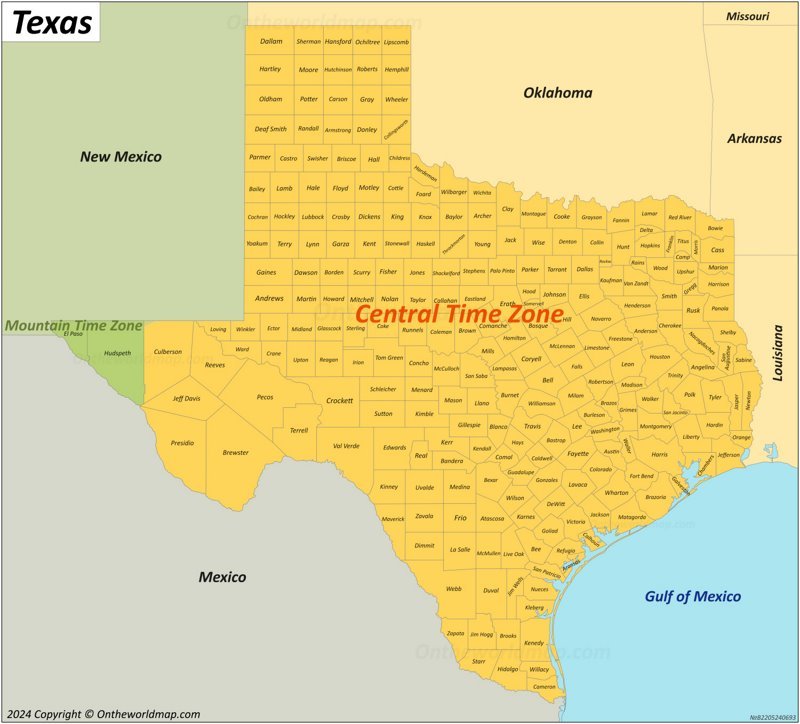
- Western Exception: Today, three Texas counties – El Paso, Hudspeth, and parts of northwestern Culberson – unofficially operate on Mountain Time, despite being legally in Central.
- DFW's Consistency: Dallas and Fort Worth have consistently remained within the Central Time Zone, critical for their role as a major economic and transportation hub.
- Daylight Saving: Dallas observes Daylight Saving Time, with predictable shifts that significantly impact local operations and routines.
Before the Clock: A Patchwork of Local Times
For centuries, time was a local affair. Farmers, merchants, and everyday citizens simply looked to the sky. Noon was when the sun reached its highest point, and every town, city, and even isolated ranch set its clocks—or, more often, its watches and bells—according to its own astronomical meridian. This system, known as "local solar time" or "true local time," worked perfectly well when travel was slow and communication limited. A trip of even 50 miles east or west could mean your clock was off by several minutes from the local standard, but who cared? You adjusted.
Texas, a vast state stretching across more than 800 miles from east to west, would have presented an extraordinary challenge under such a system. Imagine traveling from Beaumont to El Paso, traversing dozens of communities, each with its subtly different "noon." This seemingly quaint system was about to collide head-on with an industrial revolution driven by speed and precision.
The Railroads Ride to the Rescue (and Chaos): Forging a Standard
The advent of railroads in the mid-19th century utterly shattered the viability of local solar time. Trains were fast, carrying people and goods across hundreds, even thousands of miles. A train schedule based on Boston's local time would be wildly inaccurate in Chicago, let alone Dallas. With dozens of different local times across the United States, managing train operations became an unholy mess.
Think about it: A conductor trying to avoid collisions on a single track, relying on a timetable where "10:00 AM" in one town could mean "9:52 AM" in another and "10:07 AM" in a third, was a recipe for disaster. Accurate scheduling, passenger convenience, and basic safety demanded a radical solution. This pressing need for synchronization led railroad companies to take matters into their own hands.
On November 18, 1883, a day often dubbed "The Day of Two Noons," the major U.S. and Canadian railroads unilaterally adopted a system of four standard time zones: Eastern, Central, Mountain, and Pacific. They largely followed the scheme proposed by Canadian railway engineer Sandford Fleming. This wasn't a law; it was an industry standard, but its impact was immediate and profound. Suddenly, towns and cities across North America found their local "true noon" replaced by a railway-mandated "standard noon." While initially controversial, most communities quickly adopted the new system simply because it was more practical for travel and commerce. To truly appreciate this pivotal moment, it's worth diving into the full story of the role of railroads in time zone creation.
Texas Enters the Time Zone Fray: Early Adoptions and Discrepancies
When the railroads implemented their time zones in 1883, Texas, due to its geographic expanse, found itself straddling two proposed zones. The vast majority of the state fell within the Central Time Zone, largely aligning with the 90th meridian. However, the far western reaches of Texas, particularly the area around El Paso, naturally aligned more closely with the Mountain Time Zone (105th meridian).
This unofficial adoption meant that, for decades, time zones were still somewhat fluid and subject to local interpretation, even if the railroads tried to impose order. Cities like Dallas and Fort Worth, already growing hubs for rail traffic, quickly aligned with Central Time, seeing the practical benefits for their burgeoning industries and connections to the rest of the Central U.S.
One particularly interesting historical footnote concerns the Texas Panhandle. While mostly in Central Time today, between 1919 and 1921, this region was officially in the Mountain Time Zone. This temporary shift highlights the ongoing adjustments and occasional confusion that followed the initial standardization efforts, as different regions grappled with where they best fit within the new national clockwork.
The Standard Time Act of 1918: Federalizing the Zones
While the railroads' system provided much-needed order, it lacked legal backing. This changed with the passage of the Standard Time Act of 1918. This landmark federal legislation officially established the existing standard time zones (Eastern, Central, Mountain, and Pacific) and placed the responsibility for regulating them under the Interstate Commerce Commission (ICC). This act effectively codified the system that the railroads had initiated decades earlier, making it law rather than just an industry agreement.
For Texas, the Standard Time Act largely cemented its position within the Central Time Zone. The dividing line between Central and Mountain Time was drawn generally along the 103rd meridian, which placed most of the state, including Dallas and Fort Worth, firmly in Central Time. It also officially sanctioned the practice of Daylight Saving Time, though its implementation would remain sporadic and controversial for decades before becoming a national standard.
Dallas and Fort Worth: Anchored in Central Time
From the earliest days of time zone standardization, Dallas and Fort Worth have been firmly entrenched in the Central Time Zone. Located at 32.78306, -96.80667, Dallas's position is squarely within the geographical bounds of this zone, roughly midway between the 75th and 105th meridians that define its borders.
This consistent placement has been crucial for DFW's development as a major economic and logistical hub. Operating on the same time as Chicago, St. Louis, and New Orleans, and only an hour behind New York, facilitates business operations, trade, and communication with other key markets in the U.S. Imagine the complications if DFW were consistently out of sync with its primary business partners; it would be a constant headache for scheduling meetings, managing supply chains, and coordinating financial transactions. The stability of its time zone status has been an unheralded but vital ingredient in the Metroplex's growth. For specific details on the moment, you can always check the current time in Dallas Fort Worth.
Texas's Time Zone Anomaly: The Western Edge's Unique Position
Despite the federal standardization, Texas remains a fascinating case study in time zone quirks. While the vast majority of the state, including all major metropolitan areas like DFW, Houston, and San Antonio, observes Central Time, there are notable exceptions on its far western frontier.
Specifically, El Paso County, Hudspeth County, and a northwestern portion of Culberson County (particularly around Guadalupe Mountains National Park) unofficially observe the Mountain Time Zone. "Unofficially" is the key word here. Legally, the 1918 Standard Time Act, as later amended by the Uniform Time Act of 1966, places these counties within the Central Time Zone. However, due to their proximity to New Mexico and cultural ties to the Mountain West, these communities have historically chosen to align their clocks with Mountain Time.
This local custom has persisted for decades. Businesses, schools, and local residents in El Paso simply operate on Mountain Time. While state agencies and some federal operations technically adhere to Central Time, the practical reality on the ground is different. This creates a fascinating and sometimes confusing situation, where a traveler crossing into El Paso from the east effectively "loses" an hour without an official time zone boundary to mark the shift. This unique situation highlights the tension between federal legislation and local practicality and makes understanding Texas's unusual time zone boundaries a surprisingly complex topic.
Why the Unofficial Mountain Time?
The reasons for El Paso's adherence to Mountain Time are primarily geographic and economic:
- Geographical Alignment: El Paso lies significantly west of the 103rd meridian (the legal boundary between Central and Mountain Time). Observing Central Time would mean that true solar noon would occur very late in the afternoon, around 2 PM, which feels unnatural.
- Proximity to New Mexico: El Paso's most immediate and integrated neighbors are in New Mexico, which observes Mountain Time. Aligning with them simplifies cross-border commerce, travel, and communication.
- Community Preference: Generations of residents and businesses have simply grown accustomed to Mountain Time, and there's strong local sentiment to maintain it.
The Daylight Saving Dance: Adjusting to Modern Rhythms
Beyond the standard time zones, the concept of Daylight Saving Time (DST) adds another layer to our historical context. First implemented nationally during World War I to save energy, DST has had a stop-and-go history in the U.S. before becoming standardized with the Uniform Time Act of 1966.
Dallas, like most of Texas, actively observes DST. This means that on a specific Sunday in March, clocks "spring forward" one hour, and on a Sunday in November, they "fall back." For 2025, clocks in Dallas will advance one hour on Sunday, March 9, 2025, from 2:00 AM directly to 3:00 AM. They will then return to standard time on Sunday, November 2, 2025, moving from 2:00 AM back to 1:00 AM.
These twice-yearly transitions, while seemingly minor, have a substantial impact on daily life in DFW. Public transportation schedules must be adjusted, business districts need to recalibrate opening and closing times, educational institutions account for the change in class schedules, and municipal services modify their operations. For residents, it means adjusting daily routines, sleep patterns, and the timing of various appointments. The discussions around whether DST truly serves its intended purpose or merely creates an annual disruption are ongoing, making how Daylight Saving Time affects daily life in DFW a topic of continuous debate.
Beyond the Hour Hand: The Economic and Social Echoes of Time Zones
The historical evolution of time zones in Texas and DFW isn't merely a tale of regulatory changes; it has tangible economic and social consequences that continue to shape the region.
Business and Commerce
For Dallas-Fort Worth, its consistent position in the Central Time Zone is a strategic advantage. It allows for efficient business operations with the East Coast (only one hour difference) and reasonable overlap with the West Coast (two hours difference). This facilitates communication, scheduling, and market access for the numerous finance, technology, and corporate headquarters located in DFW. Companies headquartered here, or those with significant operations, must also consider the time differences when dealing with the anomalous Mountain Time zone of El Paso or international partners. This often requires sophisticated scheduling tools and an awareness of these subtle but critical variations. To navigate these complexities, exploring how businesses in DFW manage time zone differences is essential for effective operations.
Transportation and Logistics
Given DFW's role as a major transportation hub—home to Dallas/Fort Worth International Airport (DFW), one of the busiest airports in the world, and extensive freight rail and trucking networks—standardized time is paramount. Precise scheduling of flights, trains, and truck deliveries relies entirely on a common understanding of time. Historical inconsistencies in timekeeping posed significant logistical hurdles, which the standardization efforts largely resolved, enabling the smooth flow of goods and people that defines modern DFW.
Public Services and Education
From school bell schedules to emergency service deployments, public institutions rely heavily on accurate and consistent timekeeping. The historical shift from localized times to a unified zone simplified coordination across municipal boundaries within the Metroplex and across the state. Daylight Saving Time adjustments, while brief, require careful planning for these services to ensure continuity and minimize disruption.
Debates and the Future: Is Standard Time Still Our Standard?
The historical context of time zones in Texas isn't static; it's part of an ongoing conversation. In recent years, there have been renewed debates across the United States, including in Texas, about the continued relevance and wisdom of both time zones and Daylight Saving Time.
Some argue for eliminating DST entirely, pointing to studies suggesting minimal energy savings and potential negative health impacts from the biannual clock changes. Others advocate for Texas to adopt a single time zone year-round, or even for certain parts of the state to shift zones. These discussions reflect a modern society questioning whether the solutions of the past still serve the best interests of the present and future. Understanding the historical path helps inform these contemporary conversations about debates around the future of time zones in Texas and whether the "standard" will continue to evolve.
Untangling the Texas Time Zone Myths: Common Questions Answered
Understanding the nuances of time in a state as large as Texas can lead to a few misconceptions. Let's clarify some common questions:
Q: Is all of Texas in the Central Time Zone?
A: No, not officially, but largely for practical purposes. While most of Texas is legally in the Central Time Zone, El Paso County, Hudspeth County, and northwestern Culberson County unofficially observe Mountain Time.
Q: Why did the Texas Panhandle briefly switch to Mountain Time?
A: Between 1919 and 1921, the Texas Panhandle was officially designated within the Mountain Time Zone following the Standard Time Act of 1918. This was a brief period of adjustment as the federal government solidified time zone boundaries. It was later reverted to Central Time, likely due to economic ties and alignment with the majority of the state.
Q: Does Dallas always observe Daylight Saving Time?
A: Yes, Dallas, like the vast majority of Texas, observes Daylight Saving Time (DST), springing forward in March and falling back in November.
Q: If El Paso is "unofficially" on Mountain Time, what does that mean legally?
A: Legally, according to federal statute, El Paso and the other western counties are in the Central Time Zone. However, local custom, supported by civic and business practices, dictates they operate on Mountain Time. This generally doesn't cause major legal issues unless a specific federal regulation or court case requires strict adherence to the statutory time.
Q: How did railroads influence time zones in Texas specifically?
A: The expansion of railroads across Texas in the late 19th century made the state's diverse local solar times unmanageable. The railroads' self-imposed standardization in 1883 largely set the pattern for Texas's inclusion in the Central Time Zone, paving the way for the later federal legislation.
Navigating Texas Time: What You Need to Know Today
The historical journey of time zones in Texas and DFW reveals a persistent drive for order out of chaos, balancing local preference with national standards. For anyone living in or traveling to Dallas-Fort Worth, the takeaway is clear: you're firmly in the Central Time Zone, adjusting for Daylight Saving Time twice a year.
However, a journey to the far western edge of the state, especially El Paso, requires a conscious mental shift. Understanding this historical evolution isn't just about knowing when something happened; it's about appreciating the complex interplay of geography, technology, legislation, and human behavior that defines the very rhythm of our modern lives. So, the next time you glance at your watch in Dallas, remember the centuries of shifting suns, railroad timetables, and federal acts that brought us to this perfectly synchronized moment.